


PROJECT
Developing and embedding an ecosystem map for the UK National Measurement System (NMS) at the National Physical Laboratory (NPL) using Soft Systems Methodology (SSM).
PRACTITIONER
Thomas Rowe, Systems Thinking Impact Manager, National Physical Laboratory
SITUATION AND CONTEXT
The UK’s NMS is a ~£100m per annum programme delivered on behalf of the Department for Science, Innovation and Technology (DSIT) through multiple Designated Institutes, with NPL, the UK’s National Metrology Institute, delivering most of the programme. Over its 40 years of delivery, the NMS scope had expanded to include innovation and wider dissemination of measurement science and engineering in industry and government.
This resulted in a complex stakeholder ecosystem that was difficult to define, visualise and describe consistently. Roles, relationships, and dependencies were understood in fragments across teams, resulting in challenges for strategic planning, stakeholder engagement, and connecting evaluation activities to the ecosystem.
SYSTEM OF INTEREST
The system of interest was the NMS stakeholder ecosystem that the programme delivers into, defined in terms of how programme outcomes are realised through stakeholder interactions that create direct and indirect impact pathways. The focus was to structure stakeholders into programme-relevant clusters and visualise the relationships, dependencies, and exchanges between them.
APPROACH TAKEN
SSM was chosen to work with multiple worldviews and to iteratively move from rich pictures to a purposeful, usable model. CATWOE was used to structure relationship statements and make assumptions explicit and comparable.
MODELS AND INSIGHTS DEVELOPED
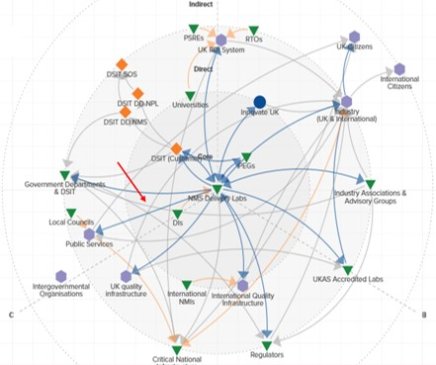
- An ecosystem map at the NMS programme-level, iterated from rich picture workshops and one-to-one stakeholder interviews, developing an initial assumptive model of the NMS ecosystem. The map visualised a large set of stakeholders and interconnections, with relationships structured through CATWOE statements.
- Seven purposeful activity systems were identified, named NMS sub-systems (Accreditation, Regulation, National Capability & Security, Innovation, International, Standards, Knowledge Transfer), through analysis of ecosystem relationships and actors within the ecosystem.
- The map challenged ambiguity in stakeholder definitions, defining stakeholder clusters and recognising adjacent systems, including the UK’s Research, Development, and Innovation (RDI) system.
KEY INTERVENTIONS UNDERTAKEN
The practitioner developed a v1 draft of the NMS ecosystem map through rich picture workshops and one-to-one interviews. The map was then tested with Programme Management, Stakeholder Engagement, and Analysis & Evaluation teams to assess benefits in identifying gaps in stakeholder validation, developing engagement strategies and plans, and linking evaluation evidence to impact pathways.
RESULTS
The project produced a navigable ecosystem map of a previously hard-to-visualise NMS system, positioned as a shared programme asset and reference point for stakeholder clusters, relationships, and the distinct purposes represented as sub-systems.
It reduced fragmented understanding by helping teams locate discussions within the wider ecosystem, use more consistent language, and surface assumptions and knowledge gaps. It also supported onboarding, enabling new staff and collaborators to understand the NMS ecosystem in around an hour rather than building partial understanding over months.
Using the map, the programme compared mapped stakeholder clusters against Programme Expert Group representation, identified gaps, and proposed feasible and desirable additions to external stakeholder involvement in validation.
The map also strengthened links to evaluation. Its impact pathways aligned with existing analysis and evaluation practice and provided a structure to connect programme metrics and logic models to specific stakeholder clusters.
The approach has since been adopted in other NPL major programmes and is being developed into governance as an early requirement for programme mobilisation and business case development.
AFTERTHOUGHTS & OTHER METHODS THAT MIGHT HAVE ASSISTED
Teams engaged most when the map was expressed in their existing language and tools. Two key areas of adoption were Analysis & Evaluation and Stakeholder Engagement.
Analysis & Evaluation teams engaged with the map early because its impact pathways aligned with established logic model practice and helped them link evidence and spend to specific stakeholder connections across the ecosystem, making the map immediately useful rather than abstract. Stakeholder Engagement Lead started to commission the approach within their programmes as a practical way to engage with complexity and define critical stakeholders in their programme ecosystems, where before programmes were using more basic stakeholder maps.
Engaging missing or marginalised perspectives at scale is likely to require deeper navigation of organisational power dynamics and decision-making boundaries. Assistive methodologies could benefit from Critical Systems Heuristics (CSH) to make boundary judgements explicit.
In evaluating the intervention itself, VSM could be used to map the use and benefits of the ecosystem map across a programme’s organisational structure.
