


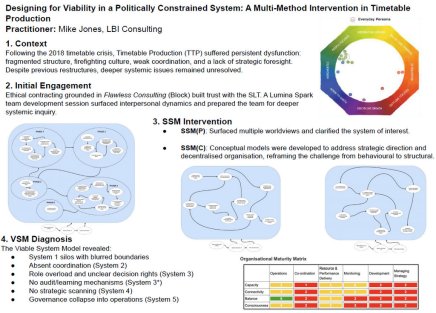
PROJECT Designing for Viability in a Politically Constrained System: A Multi-Method Intervention in Timetable
Production
PRACTITIONER Mike Jones, LBI Consulting
CONTEXT
Following the 2018 timetable crisis, Timetable Production (TTP) suffered persistent dysfunction:
fragmented structure, firefighting culture, weak coordination, and a lack of strategic foresight.
Despite previous restructures, deeper systemic issues remained unresolved.
Initial Engagement
Ethical contracting grounded in Flawless Consulting (Block) built trust with the SLT. A Lumina Spark
team development session surfaced interpersonal dynamics and prepared the team for deeper
systemic inquiry.
SSM Intervention
● SSM(P): Surfaced multiple worldviews and clarified the system of interest.
● SSM(C): Conceptual models were developed to address strategic direction and decentralised organisation, reframing the challenge from behavioural to structural.
VSM Diagnosis
The Viable System Model revealed:
● System 1 silos with blurred boundaries
● Absent coordination (System 2)
● Role overload and unclear decision rights (System 3)
● No audit/learning mechanisms (System 3*)
● No strategic scanning (System 4)
● Governance collapse into operations (System 5)
Supported by SCiO’s Organisational Maturity Model, the diagnostic phase revealed Control Dilemmas, Identity Crises, and cultural barriers to change.
VSM Redesign
The redesign followed recursive VSM principles:
● System 1: SLT co-developed six structural options. A structured option-scoring matrix was used to reduce bias. The LTP/STP split was selected, aligned to operational reality and stakeholder needs.
● System 3: IDEF0 models mapped roles and decision rights. Management reduced from 63 to 17. Clear spans of control and accountability defined.
● System 2: Introduced shared planning templates, coordination meetings, and aligned stakeholder forums.
● System 3*: New audit/change roles to support continuous learning and insight.
● System 4: Established Future Development function and Patterns of Strategy integration to model external positioning.
● System 5: Strategic governance restructured. Decision rights mapped and monthly oversight forums established.
Strategic Manoeuvring with Patterns of Strategy
Used to model TOCs, FOCs, and internal routes. Mapped shifts (e.g., from Influence to Strategic Partner) to improve ecosystem position. Enabled the SLT to make context-sensitive, relationally aware strategic moves.
Mosaic Transformation
32 interdependent change packets were designed and sequenced using the Mosaic framework. These addressed systemic constraints, enabling safe-to-fail experiments and adaptive change. Weekly reviews and learning loops supported recursive implementation.
OUTCOMES
● Management headcount reduced from 72 to 18
● Structural clarity embedded across delivery, coordination, and governance
● Strategic foresight embedded (System 4 operational)
● Increased trust, reflexivity, and leadership capability
● SLT now capable of leading complexity-informed change

Events associated with this resource
There are no events associated with this resource.