


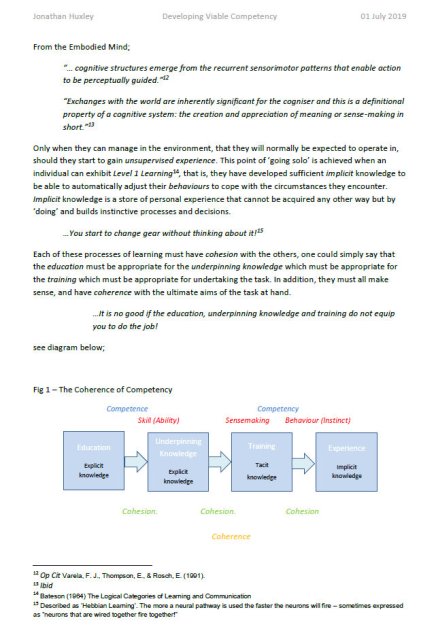
Viable competency describes a system of skills and behaviours that fit together cohesively to create a coherent, meaningful, enaction with the user’s environment that can be sustained through the system’s own self-maintaining mechanisms. They allow an individual or group to anticipate events and to learn and adapt to changing circumstances to maintain their professional ability.
The term ‘viable’ in this context is taken from Stafford Beer’s Viable Systems Model1. Beer demonstrated that a viable system could maintain itself in balance with its environment through five key components. These were the cohesion of its autonomous sub-systems, the coherence of their emergent properties to achieve a shared purpose, the ability to anticipate and adapt to change and finally, to be able to protect the system from perturbations in the environment by the ‘closure’ of these sub-systems through a recursive implementation of their processes.
This article will explain the constituent components of competency, how they are developed and how they have to be maintained to create a viable system of professional conduct that has to be embedded in any organisation to sustain its existence.
